
SOCIAL PROJECTS
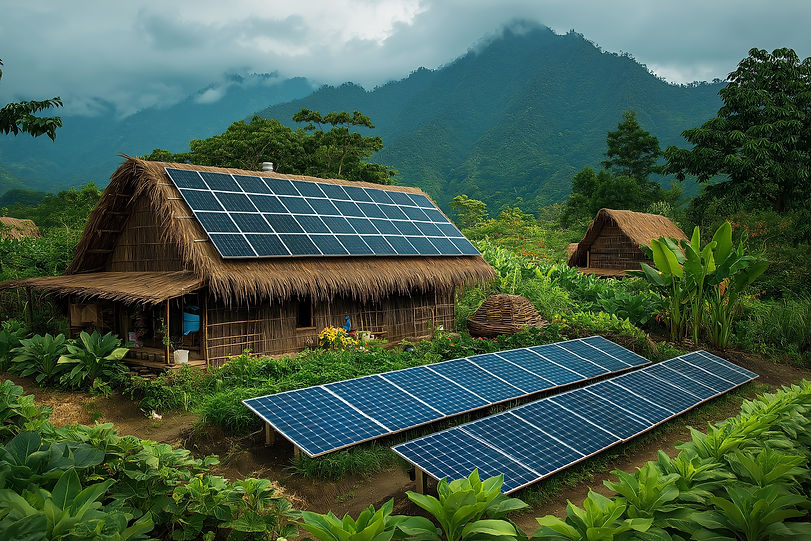
Supporting Local Communities with their Indsutries and Public Infrastructure in Disadvantaged Areas with sustainable solutions for Energy Supply and Cooling Chain Implementation. Guaranteeing Sustainable Local Food Supply, Waste Management, Education & Employment to Strengthen Social Cohesion.
Sample Project
Implementation of a Basic Fishery Cooling Chain on the Pacific Islands
Ice blocks without diesel generators and environmentally harmful expensive diesel fuel but completely climate-neutral thanks to solar power. Environmentally friendly and sustainable technology development. Food production is an important economic sector in Asia and the Pacific Island states. However, many small-scale fishermen were often left behind from trade flows because they lacked technological infrastructure. Technology from WAVELINK ENGINEERING should now help you. This is made possible by a solar-powered ice machine for producing ice blocks. “The fish do not spoil, the ice production is completely climate-neutral using solar energy.” However, small-scale fishermen who practice environmentally friendly fishing methods are often unable to transport their fish to consumers due to a lack of cooling options. The result: small-scale fishermen can hardly hold their own against industrial fishing; Many fish spoil and the fishermen become impoverished. WAVELINK ENGINEERING wants the fish stocks and secure the income of fishermen in remote areas. What is crucial for this is the complete cooling of the catch using a solar-powered ice machine and a refrigerated vehicle for transport to consumers in the remote highlands. The innovative technology ensures dynamic ice production of 2.4 to 5 tons of block ice per day, which is automatically adapted to the available solar energy. This requires neither a power connection from diesel generators nor an expensive, large battery storage system. This allows ice blocks to be produced in off-grid locations and used to cool locally caught fish. “This secures the income of fishermen who operate sustainably, especially in remote and low-income regions in Asia & the Pacific.” Multi-purpose buildings such as secondary schools, Sunday church services, leisure activities and meetings are available for the village communities, including a roof solar system the Pacific islands and the Abgalden highlands. Including: Ice blocks without diesel generators and environmentally harmful expensive diesel fuel but completely climate-neutral thanks to solar power.
Environmentally friendly and sustainable technologies
First:
Drinking water treatment
Water treatment:
Water treatment is the targeted change in water quality. It is a branch of process engineering and essentially includes two groups of treatment: removal of substances from water; Addition of substances and adjustment of water parameters.
Water treatment plants
• Open processing.
• Closed processing.
• Osmosis filtration.
• Nanofiltration.
• Ion exchanger.
• UV filtration.
• Dosing devices.
Processes suitable for water purification: Physical methods of water purification include sedimentation, filtration, boiling, distillation, desalination and reverse osmosis. Flocculation, chlorination and coagulation are the most commonly used methods of chemical water purification.
Second: wastewater treatment
Third: waste incineration plants
Sustainable technology development looks for technical solutions from the energy and mobility sector in order to improve people's living conditions in line with the UN SDGs without negative ecological or social consequences. Minimizing environmental impact
Summary Wastewater treatment and reuse as process water. Furthermore, proposed solutions are discussed for reducing the greenhouse gases typical in agriculture as well as for the recycling of solids from household waste. farmers and the population of rural areas. Farmers are currently receiving for the agricultural products do not receive the price equivalent for the work they have done. The population in rural areas is suffering from the exodus of young people and the collapse of infrastructure.
Both groups can independently and sustainably improve this situation through independent action, because the arable land offers the potential for future new products for energy supply. We also offer strategies for obtaining food and energy in agro-energy complexes. For this purpose, synergisms in production in plant and energy production are also discussed from the perspective of a climate-related, temporary water shortage, as well as the advantages of using clear water to irrigate arable land. The use of phosphate and ammonium ions as complete fertilizers from wastewater recycling also seems to be not insignificant. Both target groups mentioned above achieve a noticeable improvement in their living conditions through education Cultivation and user communities.